
Does AI Need People? The Interim Team Behind Your GBS Automation & AI Initiatives
Does AI need people? Interim ones, at least. A GBS center can buy the automation platform in a week and license the AI model in an afternoon; what it cannot buy off the shelf is the transformation lead, the P2P process expert and the data engineer who turn those licenses into a working process — and it usually needs each of them for a defined period only.
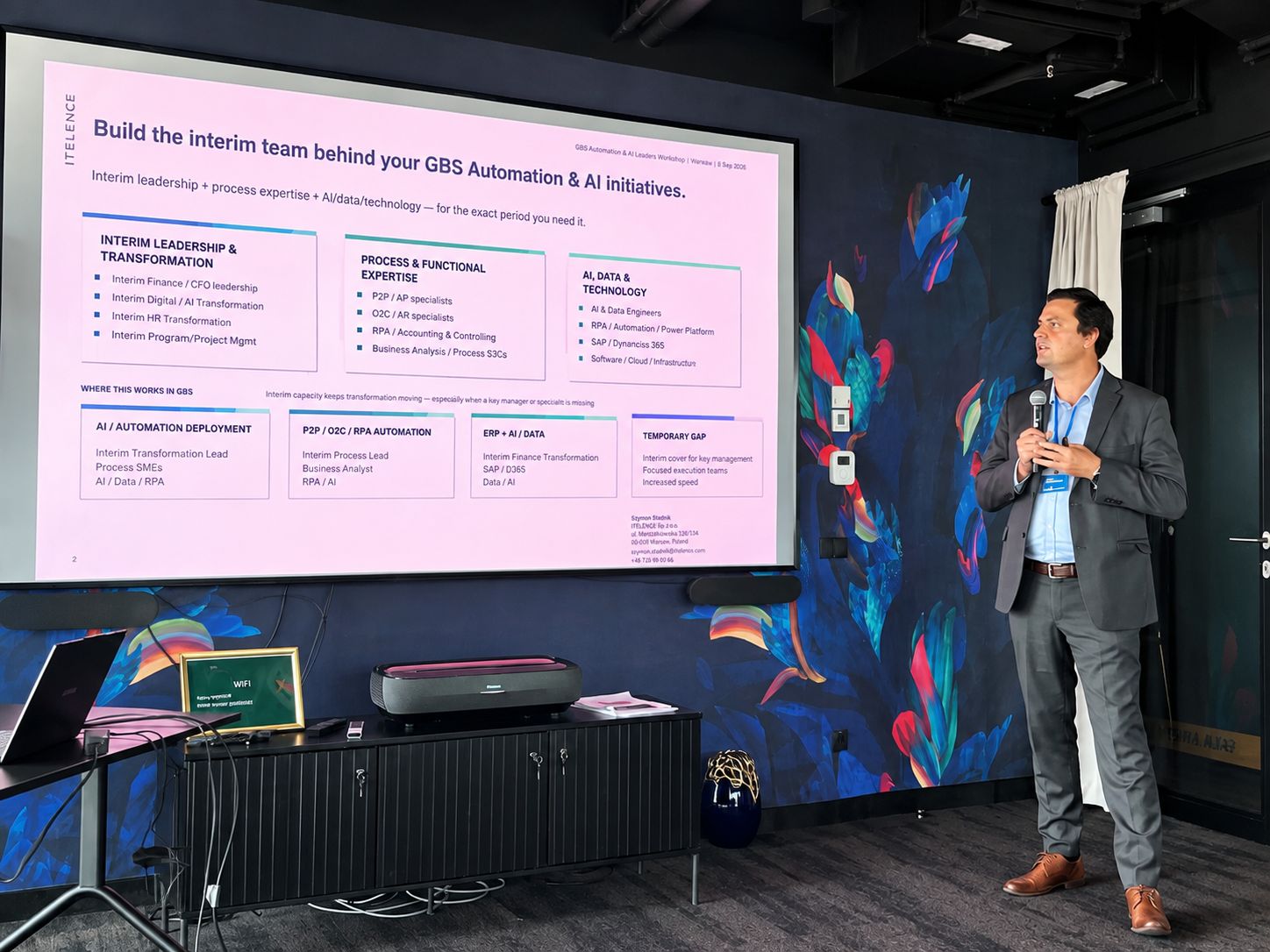
That question — the title of Szymon Stadnik’s presentation at the GBS Automation & AI Leaders Workshop 2026 in Warsaw — has a practical answer. Every automation and AI initiative in a shared services organization runs on people, and most of those people are needed for a defined period only. This article covers what was discussed at the event, why transformation programs stall on capability rather than technology, and how an interim team fills the gap without turning your leadership into a full-time hiring desk. It is written for GBS directors, finance transformation heads and CFOs who own an automation roadmap — and who are looking at interim leadership and flexible finance teams as one way to keep that roadmap on schedule.
Key Insights
- Transformation creates temporary capability gaps, not permanent headcount needs — a P2P automation rollout needs a process lead, a business analyst and an RPA/AI developer for 6–12 months, after which the run team is a fraction of that size.
- Interim talent augmentation is a fourth model, distinct from recruitment (permanent, slow), consulting (advice, not execution) and outsourcing (a supplier owns the outcome) — interim specialists execute inside your governance for the exact period you need them.
- Polish business services centers are already automating at scale — 90% of firms use AI for cognitive tasks and 74%+ have deployed intelligent automation, according to ABSL’s Business Services Sector in Poland 2025 report. The bottleneck is people who can run the next wave, not tools.
- Three capability pillars cover almost every GBS AI project — interim leadership and transformation, process and functional expertise (P2P, O2C, R2R), and AI/data/technology (AI and data engineers, RPA, SAP, Dynamics 365, cloud).
- Interim cover is a leadership-focus tool — when a key manager leaves mid-program, an interim replacement keeps the transformation lead working on the transformation instead of running a replacement search for four months.
- Deployment is measured in days, not quarters — Itelence places interim finance and transformation leaders in 10–14 business days and operational specialists in 5–10 business days, based on our current engagements in Poland.
- Interim talent management has one job: make sure the knowledge stays — a defined exit plan, documented process ownership and a named internal successor from day one decide whether the program survives the interim’s departure.
What happened at the GBS Automation & AI Leaders Workshop 2026 in Warsaw?
The GBS Automation & AI Leaders Workshop 2026, organized by the European Business Services Association on 8 September 2026, brought together a closed group of about 50 GBS executives at Central Point in Warsaw for a day of benchmarking and technology case studies. The format was deliberately practical: a keynote from Michał Targiel, PwC Partner leading Intelligent Business Process Automation, followed by two blocks of 12-minute case studies from operating GBS organizations, two peer roundtables and a Deloitte segment with five further case studies. The day closed with the Top AI Use Case in GBS awards, won by Astellas Pharma, Holcim Global Hub Business Services and Concentrix.
The case studies covered order-to-cash automation, enterprise AI adoption, talent upskilling, order processing, autonomous IT operations and payroll quality assurance. Roundtable participants included executives from Arxada, BNP Paribas, Warner Bros Discovery, thyssenkrupp, Hapag-Lloyd, Husqvarna and NatWest Poland. Itelence took part as a presenter, and Szymon Stadnik, CEO of Itelence, used his slot for a topic that sat slightly apart from the tooling discussions: who actually staffs these programs, and for how long.
His presentation — Does AI need people? Interim ones, at least. — made a single argument. GBS automation and AI initiatives create temporary capability gaps in leadership, process expertise, data, automation and technology. Filling those gaps with an interim team is faster than permanent recruitment, more hands-on than consulting, and keeps internal leaders focused on the transformation rather than on sourcing replacements. The rest of this article unpacks that argument, with data.
Why do GBS automation and AI programs stall on people rather than technology?
GBS automation and AI programs stall on people because the technology is now widely available and the people who can deploy it inside a specific finance, HR or procurement process are not. According to ABSL’s Business Services Sector in Poland 2025 report, AI is already used for cognitive tasks in 90% of Polish business services firms and more than 74% of centers have implemented intelligent automation. Adoption is no longer the differentiator. The differentiator is whether a center can run the second and third wave — end-to-end process redesign, data foundations for AI, integration with SAP or Dynamics 365 — with people who have done it before.
The same report shows why the internal bench is thin: 78% of firms increased investment in staff training in the past year, and 46% of employees in the sector are now aged 35 or older, reflecting a shift toward more complex, knowledge-intensive work. Training your existing team is the right long-term move. It does not, however, produce an experienced RPA architect or a finance transformation lead in the six weeks between board approval and the first sprint.
Deloitte’s 2025 Global Business Services Survey, which gathered responses from GBS leaders in more than 30 countries, adds the global picture: 66% of responding organizations plan to invest in generative AI in the next three years, and skill set gaps, high turnover and increased labor costs remain the talent challenges most frequently cited. Put the two datasets together and the pattern is clear — the demand for transformation capability is rising faster than centers can build it internally.
What is a temporary capability gap, and where does it appear in a GBS transformation?
A temporary capability gap is a skill or leadership role that a transformation program needs for a defined phase — typically 3 to 18 months — but that the organization does not need permanently at the same intensity afterwards. It is different from a vacancy. A vacancy is a permanent seat that happens to be empty; a capability gap is a seat that only exists while the program runs. Treating the second like the first is why so many GBS centers open permanent requisitions for roles they will not need in two years.
In practice, four types of gap appear in almost every GBS automation and AI initiative. The table below maps each one to the moment in the program where it typically surfaces and to the interim role that closes it.
| Capability gap | When it appears | Typical symptom | Interim role that closes it |
|---|---|---|---|
| Leadership | Program kick-off, or when a transformation lead or finance manager leaves mid-program | Steering committee meets, decisions do not get made; workstreams drift | Interim Finance / CFO leadership, Interim Digital / AI Transformation lead, Interim Program Manager |
| Process expertise | Design phase — mapping the as-is P2P, O2C or R2R process before automating it | Bots automate a broken process; exceptions multiply instead of shrinking | P2P / AP, O2C / AR, R2R / Controlling specialists, Business Analysts, Process SMEs |
| Data | The moment an AI use case moves from pilot to production | Model works on the demo dataset, fails on live master data | AI & Data Engineers, Master Data specialists |
| Automation & technology | Build phase — integration with SAP, Dynamics 365, Power Platform or cloud infrastructure | Internal IT queue is 6 months long; the program waits | RPA / Power Platform developers, SAP / D365 consultants, Cloud and Infrastructure engineers |
The gaps rarely appear one at a time. A finance-led AI deployment usually opens a process gap and a data gap in the same quarter, and if the program sponsor changes jobs halfway through, a leadership gap on top. This is the scenario Szymon described from the stage: the internal team is capable, but it is now running the center, redesigning the process, cleaning the data and covering for a missing manager at the same time.
What is interim talent augmentation for AI projects, and how does it differ from recruitment, consulting and outsourcing?
Interim talent augmentation for AI projects means adding experienced specialists — leaders, process experts, engineers — to your own team for the duration of an AI or automation program, working inside your governance and reporting to your management, and leaving when the program phase ends. You keep the outcome, the decisions and the process ownership; the interim partner supplies the capacity and the experience. It sits between three better-known models, and the distinction matters when you choose one.
Recruitment gives you a permanent employee, which is right for the roles that will still exist in three years — the process owner, the automation CoE lead. Consulting gives you a recommendation and, sometimes, a deck; it rarely gives you someone who stays to configure the bot and fix the exceptions in month four. Outsourcing transfers responsibility for a defined result to a supplier, which works for stable, well-documented processes and less well for a program whose scope is still moving. Interim augmentation is the model for the period in between: when the work is defined enough to execute but too temporary and too specific to hire for.
| Criterion | Permanent recruitment | Consulting | Project outsourcing | Interim talent augmentation |
|---|---|---|---|---|
| Who owns the outcome | You | You (advice only) | Supplier | You |
| Who does the hands-on work | Your employee | Usually your team, following recommendations | Supplier’s team | Interim specialist inside your team |
| Time to start | 3–6 months for senior finance and transformation roles, based on searches Itelence has run for European clients | Weeks | Weeks to months (scoping, contracting) | 5–14 business days (Itelence, 2026) |
| Commitment length | Open-ended | Per engagement | Contract term, often multi-year | Program phase; extended or ended as needed |
| Best for | Roles that outlast the program | Strategy, target operating model | Stable, documented processes | Temporary capability gaps during transformation |
| Main risk | Hiring for a role that disappears | Recommendations nobody has time to execute | Loss of process knowledge and control | Knowledge leaves with the interim unless transfer is planned |
If you want the broader comparison between augmentation and a supplier-managed model, staff augmentation versus managed services covers it in detail; the logic for interim finance and transformation roles is the same as for engineering roles.
A capability gap is slowing your automation roadmap?
Tell us which role is missing — transformation lead, P2P process expert, RPA or AI engineer — and we will confirm availability and a start date within days.
Which interim roles belong in a GBS automation and AI team?
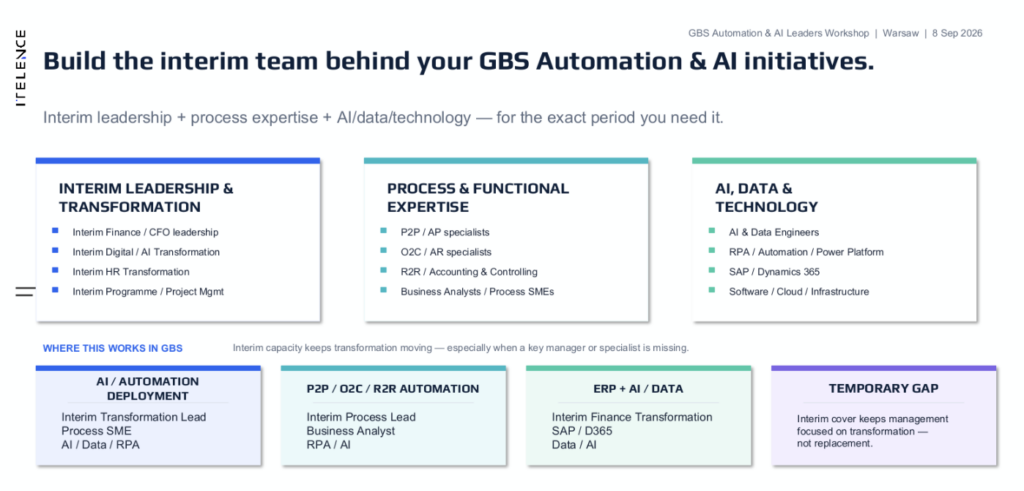
An interim team for a GBS automation and AI program draws on three capability pillars — leadership and transformation, process and functional expertise, and AI, data and technology — and most programs need at least one role from each. This is the structure Szymon presented in Warsaw, and it maps directly onto the four gap types above. The point of grouping roles this way is to stop programs from staffing only the technology pillar and then discovering, three months in, that nobody owns the process design or the steering decisions.
| Pillar | Interim roles | What they own in the program |
|---|---|---|
| Interim leadership & transformation | Interim Finance / CFO leadership · Interim Digital / AI Transformation lead · Interim HR Transformation lead · Interim Program / Project Manager | Decisions, budget, stakeholder management, steering cadence; cover for a departed manager so the transformation lead stays on the transformation |
| Process & functional expertise | P2P / AP specialists · O2C / AR specialists · R2R / Accounting & Controlling · Business Analysts · Process SMEs | As-is mapping, to-be design, exception handling rules, user acceptance testing, process documentation |
| AI, data & technology | AI & Data Engineers · RPA / Automation / Power Platform developers · SAP / Dynamics 365 consultants · Software, Cloud & Infrastructure engineers | Data pipelines and master data readiness, bot and model build, ERP integration, environments and security |
Two observations from Itelence engagements shape how we assemble these teams. First, the process pillar is the one most often skipped, because centers assume their own AP or AR team leads can do the design work on top of their day job — they usually cannot, and the program pays for it in rework. Second, the technology pillar is where Poland’s talent depth matters most: according to the Polish Investment and Trade Agency’s 2025 IT Sector Report, Poland has approximately 600,000 programmers, more than 25% of the entire development community in Central and Eastern Europe, which is why the SAP, Power Platform and data engineering roles are the fastest to fill from Warsaw, Kraków or Wrocław. Our RPA and intelligent automation services and AI consulting and engineering draw on the same pool.
“Transformation programs often create temporary capability gaps — in leadership, process expertise, data, automation or technology. Building the right interim team fills those gaps quickly and, most importantly, lets internal leaders stay focused on the transformation instead of spending their time searching for replacements or additional resources.”
— Szymon Stadnik, CEO, ITELENCEWhere does interim capacity work best in GBS?
Interim capacity works best in GBS where a program has a clear phase boundary — a go-live, a migration cut-over, a pilot-to-scale decision — and where the skills needed before that boundary differ from the skills needed after it. Szymon’s presentation grouped the strongest use cases into three program types plus one situation that cuts across all of them. Each is described below with the interim roles that typically make up the team.
How is an AI or automation deployment staffed?
An AI or automation deployment is staffed with an interim transformation lead, a process SME for the function being automated, and one or more AI, data or RPA engineers. The lead owns the use-case pipeline and the business case; the SME translates the process into rules and exceptions the engineers can build against. In our experience this is the configuration behind most of the use cases that win awards like the ones presented in Warsaw — the technology is rarely exotic, but the process and data work in front of it is done properly.
How is P2P, O2C or R2R automation staffed?
Finance process automation is staffed with an interim process lead for the relevant tower, a business analyst, and RPA or AI developers. The process lead is the role centers most often try to cover internally and most often regret. Automating accounts payable while the AP manager also runs month-end is the fastest way to automate the wrong version of the process. If your program is specifically about procure-to-pay in an SAP environment, this guide to SAP P2P teams in Poland goes deeper on the delivery side.
How is an ERP plus AI/data program staffed?
An ERP program with an AI or data layer — an S/4HANA migration with embedded analytics, a Dynamics 365 rollout feeding a reporting model — is staffed with an interim finance transformation lead, SAP or D365 consultants and data or AI engineers. The finance lead is critical here because the ERP decisions (chart of accounts, cost center design, master data governance) determine what the AI layer can do later. Our article on SAP staff augmentation covers consultant profiles and sourcing times for this scenario.
What happens when a key manager or specialist leaves mid-program?
When a key manager leaves mid-program, interim cover replaces that person for the duration of a proper search, so the transformation lead keeps running the transformation rather than the recruitment. This is the “temporary gap” case from the presentation and, in our experience, the most underestimated one. A four-month vacancy in a finance manager seat during an automation rollout does not pause the program — it pushes the manager’s work onto the program team and slows both.
How fast can an interim specialist for digital transformation start, and what does it cost?
Based on Itelence engagements in Poland as of 2026, an interim finance or transformation leader is typically deployed in 10–14 business days and an operational specialist — an AP accountant, a business analyst, an RPA developer — in 5–10 business days. Those timelines assume a defined role scope and a client available for one or two interviews; they extend when a role requires a niche combination, for example an R2R lead with both German and SAP S/4HANA experience. Compare that with permanent recruitment for a senior finance transformation role, which in the searches Itelence has run for European clients takes 3–6 months before notice periods are even counted.
On cost, three things determine the number. The first is seniority and scarcity of the profile: a Power Platform developer and an interim CFO-level finance leader are priced very differently. The second is engagement length, since longer commitments are typically priced lower per day. The third is location: interim specialists based in Poland serving a DACH, UK, Nordic or US-headquartered GBS carry a 40–60% cost advantage compared with equivalent Western European profiles, based on Itelence’s current placements — the same arithmetic that makes IT nearshoring Poland attractive for engineering teams applies to finance and transformation talent. Itelence bills interim engagements on a time-and-materials basis with a monthly invoice, so the cost tracks the program phase rather than a fixed annual salary.
From Itelence delivery experience: the roles that stretch our deployment timelines are never the technology roles. AI and data engineers, RPA and Power Platform developers and SAP consultants are consistently the fastest to place from our Polish bench. The slowest are process leads who combine deep tower knowledge (P2P, O2C or R2R) with a second language such as German or French — for those, we recommend starting the search before the program is formally approved rather than after.
This is also where the Polish business services market works in the client’s favor. KPMG’s Shared Services & Global Business Services report for Poland (May 2025) notes that 63% of surveyed centers already use Intelligent Process Automation and that Germany (73.8%), the UK (57.0%), France (44.2%) and the US (40.7%) are the top markets served from Poland. The practical consequence is a large pool of finance and automation professionals who have already worked inside a GBS serving your market, in your language, on your ERP — which is why nearshore IT services Poland and finance interim talent are increasingly sourced from the same partners. Our overview of why Poland attracts high-value IT, SSC and GBS investment has the wider market data.
How should GBS leaders manage interim talent so the knowledge stays after the contract ends?
Interim talent management has one objective that matters more than any other: the process knowledge, automation logic and decisions created during the engagement must belong to your organization on the day the interim leaves. The risk with any temporary specialist is not that they underperform — it is that they perform well and take the context with them. Four practices, applied from the first week rather than the last, prevent that.
- Name the internal successor on day one. Every interim role has a named employee who will own the process, the bot or the model afterwards, and that person is in the working sessions from the start — not briefed in the final fortnight.
- Make documentation a deliverable, not a courtesy. Process maps, exception catalogs, bot design documents and data lineage are listed in the statement of work with acceptance criteria, the same as the automation itself.
- Keep governance internal. The interim transformation lead runs the steering committee; the sponsor still chairs it. Decisions are recorded in your system, in your template, under your ownership.
- Plan the exit at the kick-off. Agree the phase boundary that ends the engagement (go-live plus one month of hypercare, for example), the handover checklist and the option to extend — so the end is a milestone, not a surprise.
Managed this way, interim augmentation strengthens the internal team rather than substituting for it. The alternative — bringing in specialists, letting them run in parallel to the organization, and rediscovering the process from scratch when they leave — is the failure mode that gives temporary staffing a bad name. Itelence’s finance and accounting outsourcing and team augmentation engagements use the same handover discipline, whether the specialists are accountants or engineers. For teams that also need longer-term engineering capacity around the automation stack, nearshore development Poland — dedicated engineers working inside your governance — follows the same principles of internal ownership and documented handover.
When is an interim team the wrong answer for a GBS AI initiative?
An interim team is the wrong answer when the capability you are missing is one you will need at the same intensity for years — in that case, recruit. It is also the wrong answer when what you actually lack is a decision, not capacity: no interim transformation lead can substitute for a sponsor who has not chosen between two operating models. And it is the wrong answer when the process is stable, well documented and not changing, because then a fully outsourced service with an SLA is cheaper and simpler than augmenting your team. Recognizing these three cases early saves money and, more importantly, credibility with the interim specialists you do bring in.
A short diagnostic helps. Interim augmentation fits when you can answer yes to most of the following:
- The role is tied to a program phase with a visible end date (go-live, migration, pilot-to-scale).
- The work needs hands-on execution inside your systems, not a recommendation.
- You want to keep ownership of the process, the data and the decisions.
- Permanent recruitment would take longer than the phase itself.
- You have, or can name, an internal successor for the knowledge.
When the answers are mostly no, look at permanent hiring, a consulting engagement or a managed service instead — and if you want a structured comparison of augmentation against recruitment for a single role, this guide to staff augmentation versus recruitment walks through the decision. The same logic applies whether the role is an RPA developer or an interim finance lead. For GBS organizations weighing captive versus outsourced delivery more broadly, shared services versus BPO in Poland sets out the trade-offs.
Itelence is a Poland-based IT outsourcing and staff augmentation company providing dedicated IT specialists, interim finance and transformation leaders, managed teams and service desk support to clients in the DACH region, the Nordics, the UK, Benelux, France and the United States. For GBS and shared services organizations, that means one partner for the interim leadership, the process expertise and the engineering capacity a transformation needs — the same model that underpins nearshoring in Poland for engineering teams, and increasingly nearshore software development Poland projects where finance and IT programs run together.
Build the interim team behind your GBS automation & AI initiatives
Interim leadership, process expertise and AI, data and technology specialists — for the exact period you need them. Talk to Szymon Stadnik and the Itelence team.
Frequently Asked Questions
Practical questions GBS and finance leaders ask before engaging an interim team for an automation or AI program.
Who manages an interim specialist day to day — the client or Itelence?
Can interim roles for a GBS program be filled remotely, or is on-site presence required?
What languages can interim finance and process specialists from Poland work in?
Can an interim specialist convert to a permanent hire later?
What happens if the interim specialist is not the right fit?
How is confidentiality handled when interim engineers work on AI models trained on our finance data?
What is the difference between interim and fractional leadership?
Can an interim team support a captive GBS as well as an outsourced one?
Do interim specialists bring their own automation tools, or work with ours?
How should a GBS write the role scope for an interim transformation lead?