
French-Language Service Desk from Poland: What Coverage Really Costs
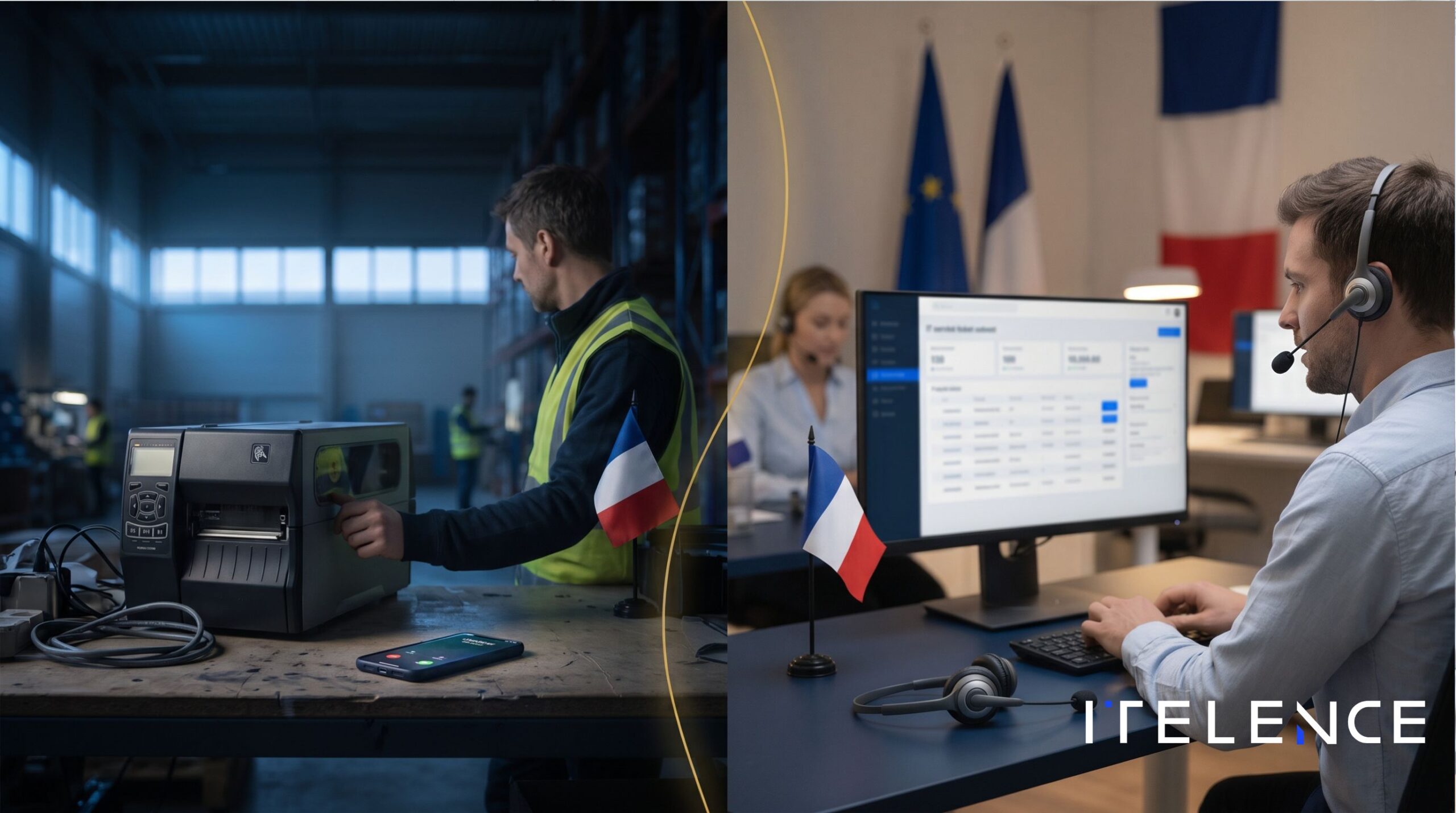
A shift supervisor at a distribution centre near Lille calls the IT service desk at 6:40 a.m. because the label printers on line three have stopped. The agent is quick, polite and speaks excellent English. The supervisor speaks school English, tries for two minutes, says “laissez tomber, je vais me débrouiller” and hangs up. No ticket is logged, the line starts late, and next month’s report shows one contact fewer than the month before.
That call is the real case for a French language service desk, and also the reason French coverage is so often budgeted badly. Some companies pay for native French around the clock and use it a few times a night. Others cover French so thinly that users quietly stop calling. This guide breaks French coverage down into the things that drive every quote: hours, agents on shift, legal obligations, language variants and holiday calendars. It is written for IT and service managers with users in France, Belgium, Switzerland, Luxembourg or Quebec, including those weighing an IT service desk run from Poland against keeping French support in-house.
Key Insights
- English-only support leaves a large share of French users behind. Eurostat’s 2022 data shows 22.6% of adults aged 25–64 in France know no foreign language, and half of those who do rate their best one as basic.
- French labour law raises the bar for written support. Article L.1321-6 of the French Labour Code requires documents employees need to do their work to be in French, which in practice reaches self-service guides and knowledge articles.
- Hours drive cost more than language does. In an illustrative model, one seat staffed 24/7 needs about three times the people of the same seat staffed 8:00–18:00 on weekdays.
- A separate French queue costs extra agents; bilingual agents win most of them back. In our example, French and English queues staffed separately need 10 agents at peak, and a shared queue of bilingual agents needs 8.
- “French” is several markets. Belgian, Swiss and Quebec users count, name things and expect service hours differently, and five public holiday calendars apply on top of the provider’s own.
- Poland’s business services sector already runs French at scale. ABSL counts 2,081 business service centres in Poland, and French sits in a lower language-allowance band than Nordic languages or Dutch.
What Is a French-Language Service Desk, and Who Actually Needs One?
A French-language service desk is an IT service desk that handles contacts from French-speaking users in French, on the phone and in writing, with knowledge articles, self-service content and quality checks prepared in French. You need one when a meaningful share of your users cannot, or will not, describe a technical problem in English under time pressure, and those users are usually not at head office.
The data points in that direction. According to Eurostat’s Adult Education Survey, 22.6% of adults aged 25–64 in France reported knowing no foreign language in 2022, rising to 32.4% among those aged 55–64. Knowing a language is also not the same as troubleshooting in it. Eurostat’s figures on self-reported proficiency show that 50.5% of French adults who speak a foreign language describe their level in their best one as basic, compared with 40.5% across the EU.
France is the obvious market, but rarely the only one. A typical French-speaking user base combines several of these groups:
- France: head office staff who may manage in English, plus plants, depots, shops and branches where most people will not.
- Wallonia and Brussels: French-speaking users in Belgium, often in the same company as Dutch-speaking colleagues in Flanders.
- Romandy: the French-speaking cantons of western Switzerland, including Geneva and Lausanne.
- Luxembourg: where French is the main working language. The Luxembourg government’s official portal describes French as the language that prevails at work, with English second.
- Quebec and francophone Africa: smaller groups for most European companies, but with their own time zones and, in Quebec, their own language rules.
The scale of the language is worth keeping in mind too. The Organisation internationale de la Francophonie now estimates around 396 million French speakers worldwide. For companies expanding in Luxembourg, our guide to IT nearshoring in Luxembourg covers how support and engineering teams for that market are usually set up.
Does French Law Require IT Support in French?
French law does not require a service desk to answer the phone in French, but it does require employers to give employees the documents they need for their work in French, and that rule reaches much of what a service desk produces. The practical consequence is that knowledge articles, self-service guides and written instructions for users in France should exist in French, whoever writes them.
Two jurisdictions deserve a closer look, because they shape what “French coverage” has to include. This is general information, not legal advice; check the details with your employment lawyer.
What does the French Labour Code say?
The French Labour Code says that any document containing obligations for employees, or provisions they need to know to perform their work, must be drafted in French. As France’s regional labour administration (DREETS) explains, the rule comes from Article L.1321-6 and goes back to the 1994 Toubon Law on the use of French. The exception for documents received from abroad or intended for foreigners exists, but the administration warns that it should be handled with caution. French courts have applied the rule to software and its documentation, most notably in a 2006 case in which an employer was ordered to translate tools its staff used every day.
For a service desk, the safe reading is simple. If a how-to guide tells a user in France how to reset a password, connect to the VPN or use a business application, treat it as a work document and publish it in French. An English-only knowledge base is a legal risk as well as a usability problem.
What changes for users in Quebec and Belgium?
Quebec goes further than France on the employee side. According to Éducaloi, a Quebec legal information organisation, all workers in Quebec have the right to work in French, including the right to ask their employer for French work documents and tools, computer software included, and employers must use French in written communications to staff in general. If your company has employees in Quebec, the self-service portal and general IT announcements should be ready in French.
Belgium has its own language legislation for employers, which depends on the region where the employee works, and it is detailed enough to deserve a separate article. For now, note that a Belgian operation may need both French and Dutch, and that the region of the workplace, not the language of the head office, decides which applies.
What Drives the Cost of French Coverage?
The cost of French coverage is driven by five things: the hours during which French is available live, the volume of French contacts, how many agents can work in both French and English, the channels covered and the content that must be translated and maintained. Language itself is rarely the biggest factor. Hours and queue size usually are.
- Coverage hours: every hour of live French needs at least one French-speaking agent on shift, whether the phone rings or not.
- Queue size: small queues need proportionally more spare capacity to answer on time, so a low-volume French queue costs more per contact than a large one.
- Bilingual share: agents who handle French and English can move between queues, which lowers the number of people you need on shift.
- Channels: phone needs the strongest spoken French; email, chat and portal tickets allow a slightly wider talent pool and some time to check wording.
- Content: translating and maintaining the knowledge base, portal and templates is a recurring cost, not a one-off project.
Because the right answer depends on your volumes, this guide does not use prices. It measures cost in what every provider’s quote is built from: agents on shift and the people needed to keep those seats filled.
How Many Agents Does French Coverage Need?
French coverage needs enough agents to meet your answer-time target on the French queue alone, which is always more than French’s share of total volume suggests. In one shared queue, any free agent takes the next call. In a separate French queue, a French speaker may sit idle while English callers wait, and the reverse, so each queue carries its own buffer.
The table below is our own illustrative calculation using the Erlang C model common in contact centres: an average handling time of eight minutes and a target of 80% of contacts answered within 60 seconds. It is not a benchmark, and your volumes will differ.
| Scenario | Contacts per hour | Agents on shift | What it shows |
|---|---|---|---|
| Day peak: separate queues | French 8 + English 30 | 3 + 7 = 10 | Each queue carries its own buffer |
| Day peak: one queue, bilingual agents | 38 | 8 | Two agents fewer for the same service level |
| Night: dedicated French agent | French 1 + English 4 | 1 + 2 = 3 | The French seat is idle most of the night |
| Night: pooled, bilingual agents | 5 | 2 | French at night adds no extra seat |
The pattern holds at most sizes. A French queue that runs separately from English costs you spare capacity on every shift, and the smaller the queue, the bigger the share of that capacity sits unused. Bilingual agents are the main lever: they let you promise French without paying for an idle French seat. That is why most well-run desks staff French with native or near-native speakers who also work fluently in English, and keep a few French-only specialists for phone queues with steady volume.
Which French Coverage Hours Are Worth Paying For?
The French coverage hours worth paying for are the hours when French-speaking users actually work and cannot wait, which for most European companies means extended weekday hours, with nights and weekends handled in English or through a callback. Full 24/7 native French makes sense mainly for round-the-clock operations such as plants, logistics or hospitals.
Hours matter because a seat is not a person. Every hour of coverage has to be filled across holidays, training, sickness and breaks. The illustration below assumes a 40-hour working week and 30% shrinkage, meaning about 28 productive hours per full-time agent; your contract and absence rates will change the numbers, but not the proportions.
| French coverage window | Hours per week | Full-time agents per seat (illustrative) | Typical fit |
|---|---|---|---|
| Business hours, 8:00–18:00 CET, Mon–Fri | 50 | ~1.8 | Office users, most French and Belgian sites |
| Extended, 7:00–20:00 CET, Mon–Fri | 65 | ~2.3 | Early shifts, retail opening hours, Quebec until early afternoon |
| 24/7 | 168 | ~6.0 | Plants, warehouses, healthcare, critical operations |
Put the two tables together and the trade-off becomes clear. Moving French from business hours to 24/7 roughly triples the people behind each seat, while adding French to a night queue staffed by bilingual agents may add no seat at all. The decision is rarely “French or no French”. It is which hours get live French, which get bilingual pooled cover, and which get English with a guaranteed French callback the next morning.
How Much French Coverage Do Your Users Need?
Send us your French-speaking headcount by site and your ticket volumes. We’ll suggest coverage hours, a staffing model and what should stay in English.
Do French, Belgian, Swiss and Quebec Users Need Different Agents?
They do not need different agents, but they need agents who know the differences, because users in each market speak a slightly different French and notice when the agent does not. A native speaker from France can serve Brussels, Geneva and Montreal well, provided the desk prepares for a handful of predictable differences.
Numbers are the classic example, and on a service desk they matter more than anywhere else. Users in Belgium and Switzerland say “septante” for 70 and “nonante” for 90, and in the cantons of Vaud, Valais and Fribourg many say “huitante” for 80. An agent who hears an asset tag or a phone number read out this way must write it down correctly the first time. Quebec users have their own everyday IT vocabulary as well, such as “clavardage” for chat, and expect a slightly different register.
A few practical rules keep this manageable:
- One standard French for written content: write knowledge articles in neutral standard French and keep a short glossary of local terms for agents.
- Market notes in the ticket: tag the user’s country so the agent knows before answering whether to expect Belgian or Quebec usage.
- Native review of templates: have a native speaker check every email template and portal text before go-live, including formal and informal forms of address.
- Phone first for native speakers: put your strongest spoken French on voice, and use bilingual agents with excellent written French for email and chat.
For L2 and L3 work, language matters much less. Engineers work from the ticket, and the ticket summary can be kept in English for consistency across countries, while the user conversation stays in French.
How Do Holidays and Time Zones Affect French Coverage?
Holidays and time zones affect French coverage because your users follow up to five different calendars and your provider follows its own, so the days when French users need support and the days when French-speaking agents are off rarely line up perfectly. The rota has to be planned against the users’ calendars, not the provider’s.
A few examples show how uneven this is. Ascension Day and Whit Monday are public holidays in France and Belgium but not in Poland, while Corpus Christi and 3 May are holidays in Poland but not in France. Belgium adds 21 July, Switzerland 1 August plus cantonal holidays, and Quebec 24 June. Some dates coincide: 11 November is a public holiday in France, Belgium and Poland alike. Since 2025, Poland has also made 24 December a public holiday, which matters for any desk covering the run-up to Christmas.
Time zones are kinder. France, Belgium, Switzerland, Luxembourg and Poland share Central European Time, so a desk in Poland covers the full French working day without night shifts. Offices in West and North Africa are between zero and two hours behind, depending on the season. Quebec is the outlier, six hours behind CET for most of the year, so Montreal’s working morning falls into the Polish afternoon and its afternoon needs a late shift until about 23:00 CET. Agree in the contract which calendar governs business-hours targets for each country, and plan holiday cover months in advance.
Why Run a French-Language Service Desk From Poland?
Companies run French-language service desks from Poland because the country combines a shared time zone with France and Benelux, an established business services sector that already works in French, and EU membership, which keeps ticket data inside the EU’s data protection framework. It is also a mature market: the same companies that buy nearshore IT services Poland for support often already work with nearshore software development Poland teams.
The sector’s size explains why French is easy to find. According to ABSL’s Business Services Sector in Poland 2025 report, Poland had 2,081 business service centres run by 1,258 investors from 50 countries at the end of Q1 2025, employing around 488,700 people. The same report shows that 60% of organisations pay language allowances and that these are largest for Nordic languages and Dutch, while French sits in a lower band alongside German. In other words, French is a mainstream language in the Polish market, not a niche one, which makes French coverage easier to staff and to back up during holidays. ABSL also reports that voluntary turnover in the sector halved from 18.3% in 2022 to 9.1% in 2024, which helps knowledge stay on the desk.
The wider talent pool supports scope that grows over time. Poland counts roughly 600,000 software developers, more than a quarter of the developer community in Central and Eastern Europe, so a service desk that later takes on application support or automation can draw on nearshore development Poland capacity from the same market. If you are already looking at nearshoring in Poland for engineering, our guide to IT nearshoring for French companies explains how French firms typically structure those teams, and the broader IT nearshoring Poland model shows how support and engineering can sit with one partner.
From Itelence delivery practice: Itelence runs a 24/7 service desk from Poland with support in English, German, French, Italian, Spanish, Dutch, Swedish, Norwegian, Polish and Czech, and other languages on request. A typical transition takes four to eight weeks, depending on scope, languages and tooling. Across recent engagements, we have delivered 95%+ SLA adherence and CSAT of 96–98%.
“At ITELENCE we want to share our nearshoring, offshoring and business experience with international corporations and support them on the road to becoming GREAT.”
— Szymon Stadnik, CEO, ITELENCEWhen Is a French-Language Service Desk Not Worth Paying For?
A French-language service desk is not worth paying for when nearly all of your French-speaking users work comfortably in English, or when they are so few that a callback from a French speaker within a few hours serves them just as well. In those cases, a live French queue adds cost without solving problems faster.
Typical examples are a Paris sales office of fifteen people who work in English every day, a software company whose Lyon team writes code and tickets in English, or a single Swiss site with an on-site IT contact who handles most issues in person. Even then, keep two things in French: the knowledge articles and guides users in France rely on, because of the Labour Code rule above, and a clear route to a French speaker when someone needs one.
The test is the same as for any language. Compare tickets per user and satisfaction at French-speaking sites with similar sites elsewhere. If French sites log noticeably fewer tickets per user, the likely reason is not that their IT works better. It is that users have stopped calling, and that is exactly the problem French coverage is meant to solve.
Support Your French-Speaking Users in French
Itelence runs a 24/7 multilingual service desk from Poland, with French on phone, chat and email, and quality reported per language.
Frequently Asked Questions
Questions IT and service managers ask most often when planning French-language support.