
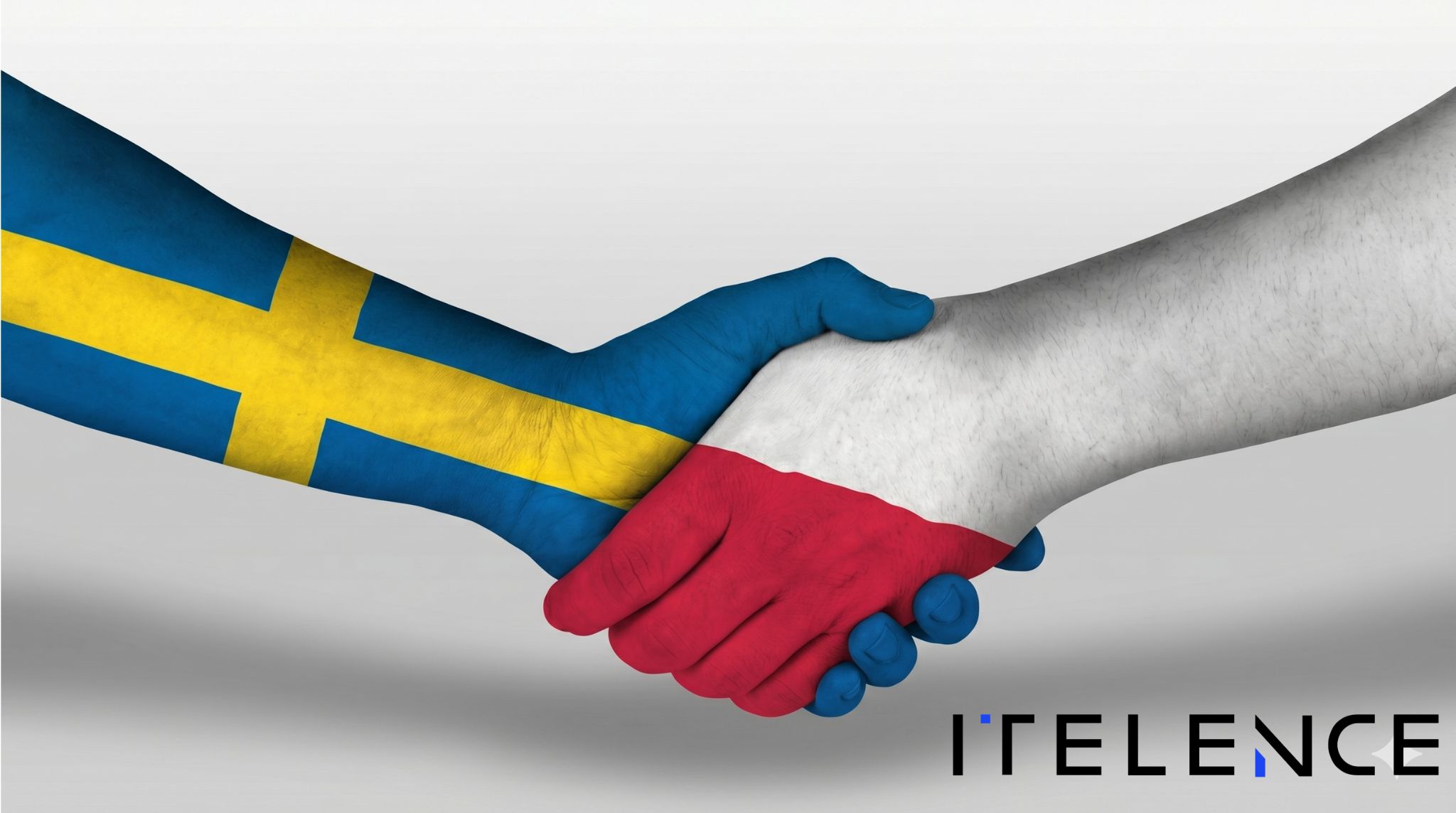
IT Nearshoring from Poland for Swedish Companies
Sweden produces some of Europe’s most recognised technology companies — Spotify, Klarna, King, Mojang — but building an engineering team in Stockholm costs more than almost anywhere else on the continent, and the local senior developer market is tight enough that the strongest candidates are typically already employed, on a long notice period, or asking for packages that stretch the budget of any company not yet at Series C.
This guide covers what Swedish technology companies need to know before engaging a nearshore partner: why nearshore services Poland has become the default answer for engineering capacity gaps across Scandinavia, what the cost model actually looks like against Swedish employer overheads, how the cultural and timezone fit plays out in practice, and what the engagement process looks like from first conversation to first sprint.
Key Insights
- Sweden and Poland share the same CET/CEST timezone — a Stockholm engineering manager and a Warsaw developer start and end the working day at the exact same time, with zero asynchronous overhead factored into collaboration or incident response.
- Sweden’s mandatory employer social contributions (Arbetsgivaravgifter) stand at 31.42% of gross salary — pushing the all-in annual cost for a senior Stockholm developer above SEK 1 million, which makes the cost gap with Polish nearshore rates structurally wider than in most other Western European comparisons.
- Stockholm Arlanda to Warsaw Chopin is a 2-hour-20-minute direct flight served multiple times daily — Swedish clients can attend a full-day planning session with their nearshore team and be back in Stockholm the same evening.
- Swedish tech culture is built on flat hierarchies, directness, and technical ownership — a working dynamic that closely mirrors how Polish engineering teams are structured and how Polish developers prefer to operate, reducing cultural adjustment to a minimum.
- EUR-denominated nearshore contracts remove the currency volatility that complicates USD-based offshore arrangements; Swedish companies budget in SEK and contract in EUR, a pairing with historically low exchange rate turbulence and no exotic settlement risk.
- Sweden’s scale-up ecosystem has normalised distributed engineering at scale — companies like Spotify, Klarna, and King have operated international engineering teams for years; adding a Polish nearshore team follows an operating model Swedish tech companies already understand.
- Polish nearshore engineers serving Swedish clients carry depth in the specific technology layers Swedish product companies rely on most: TypeScript, React, Node.js, Kubernetes, Kafka, and the data engineering stack centred on Snowflake, dbt, and Databricks.
- Sweden’s growing AI, fintech, and deeptech sectors are outpacing local talent supply — nearshore IT services Poland provides the senior ML engineers, platform architects, and data engineers that Swedish growth companies need to scale their technical teams without a six-month hiring cycle.
Why are Swedish tech companies increasingly turning to nearshore development in Poland?
The answer is straightforward once you look at the numbers rather than the pitch decks. Sweden has one of Europe’s most productive and globally recognised technology sectors — but it also has one of the most expensive engineering labour markets on the continent and a structural talent shortage that shows no sign of resolving through local hiring alone.
Swedish companies are not choosing nearshoring in Poland because it is a compromise. They are choosing it because it solves a specific problem — engineering capacity on a timeline that Swedish product roadmaps demand — without the governance overhead of offshore delivery or the commitment structure of permanent headcount growth. According to Sweden.se’s overview of the Swedish tech scene, Sweden’s technology sector is disproportionately weighted toward software product companies and scale-ups, a category where development velocity determines competitive position more directly than in any other sector. That velocity is exactly what nearshore development Poland is built to accelerate.
The model has also been tested at scale. Companies like Spotify, Klarna, and iZettle — now part of PayPal — built internationally distributed engineering organisations early in their growth. That precedent means Swedish engineering managers are comfortable operating across borders in a way that companies in more domestically focused markets sometimes are not. The cultural normalisation of distributed teams makes the transition to a Polish nearshore engagement shorter and smoother than in markets where it is a genuinely new operating model.
What makes Poland the preferred destination for Swedish nearshoring specifically?
Geography and timezone are the foundation. Poland and Sweden sit in the same time zone — both CET in winter, both CEST in summer — which means a stand-up at 9:00 in Stockholm is 9:00 in Warsaw. There is no calculation to do, no overlap window to engineer, no delayed response culture to manage. The working day is shared in full.
Beyond logistics, Poland’s talent depth matters. According to the Polish Investment and Trade Agency’s 2025 IT Sector Report, Poland has approximately 600,000 programmers — more than 25% of the entire Central and Eastern European developer community. That scale gives nearshore partners the pool depth to match Swedish companies’ requirements quickly, whether the need is for two senior Java engineers or a cross-functional team covering backend, DevOps, and data engineering. Explore the complete guide to IT nearshoring for a detailed breakdown of what the model covers and how it differs from offshoring or managed outsourcing.
What does it actually cost to hire a senior developer in Sweden vs. nearshoring from Poland?
The cost comparison is where the case for nearshore software development Poland becomes most concrete for Swedish companies. Sweden’s employment cost structure is among the highest in the OECD — not primarily because of salary inflation, though Stockholm salaries are high, but because of mandatory employer contributions that add a fixed percentage on top of every krona of gross salary paid.
The 31.42% Arbetsgivaravgifter rate — documented by Skatteverket, the Swedish Tax Agency — covers pension contributions, health insurance, parental leave funding, unemployment insurance, and several smaller mandatory levies. A senior software engineer in Stockholm earning SEK 750,000 gross costs the employer SEK 985,000 in total — before benefits, equipment, and workspace costs are added. At SEK 1,000–1,100 per day for a desk in a Stockholm co-working space, a five-person team’s fully loaded annual cost approaches SEK 6 million.
The OECD Taxing Wages 2024 report places Sweden among the highest labour tax burden countries in the OECD, a position that reflects both the Arbetsgivaravgifter rate and Sweden’s progressive income tax structure. For companies hiring at senior level — where gross salaries are highest — the employer contribution burden is fixed at 31.42% regardless of seniority, which means the cost gap between in-house hiring and nearshoring is largest at the senior and lead engineer level.
A comparable senior engineer engaged via IT nearshoring Poland typically costs between €32 and €50 per hour all-in — roughly SEK 370,000 to SEK 580,000 per year at full-time utilisation. That represents a 35–55% reduction in per-engineer cost against a Swedish in-house equivalent, a gap that widens further when recruiting fees (typically 15–20% of first-year salary in Sweden) and notice periods are factored in.
| Cost component | Senior developer in Stockholm | IT nearshoring Poland (per engineer) |
|---|---|---|
| Gross salary | SEK 720,000–900,000/year | Included in hourly rate |
| Arbetsgivaravgifter (31.42%) | SEK 226,000–283,000/year | Not applicable |
| Benefits and equipment | SEK 40,000–80,000/year | Not applicable |
| Recruiting fee | SEK 108,000–180,000 (one-time) | None |
| Total annual employer cost | SEK 986,000–1,263,000 | SEK 370,000–580,000 |
| Severance / scale-down flexibility | Statutory notice + LAS provisions | Contract termination clause (typically 30–60 days) |
Sweden’s Lagen om anställningsskydd (LAS) — the employment protection legislation — adds another dimension to the cost calculation. Permanent employees in Sweden have strong statutory protections, and scaling down a team requires following formal procedures with notice periods ranging from one to six months depending on seniority and tenure. Nearshore IT services Poland operate under a commercial contract where scaling down follows the agreed notice clause, without the procedural and legal overhead that LAS creates for permanent employment changes.
How does the timezone and travel advantage translate into day-to-day collaboration?
The timezone alignment between Sweden and Poland is not just a convenience — it fundamentally changes the collaboration model. When a Stockholm product manager files a bug report at 14:00 on a Tuesday, the Polish nearshore team has four hours of the working day remaining to diagnose, discuss, and begin a fix. There is no “we’ll pick this up tomorrow morning” delay that characterises offshore arrangements. There is no mid-morning message arriving as the team is logging off. The shared working day is complete.
This matters most in three scenarios: incident response, iterative product development, and code review cycles. All three require real-time or near-real-time communication to function efficiently. IT nearshoring Poland delivers all three without the scheduling gymnastics that US-based or South Asian offshore teams require. For a Swedish scale-up shipping weekly or bi-weekly, that difference in iteration speed compounds over the course of a product development cycle.
How often do Swedish teams travel to Warsaw, and what does that look like in practice?
The Stockholm–Warsaw route operates multiple daily direct flights, with journey time from Arlanda to Chopin at approximately 2 hours 20 minutes. In practice, this means a Swedish engineering manager can leave Stockholm at 07:00, arrive in Warsaw by 09:30, run a full-day planning session, and be back home before dinner. That round-trip is a routine working day, not a travel commitment requiring a hotel or a full day’s absence from other meetings.
Most Swedish companies working with nearshore development Poland establish a quarterly on-site rhythm — one or two people from the Swedish side flying to Warsaw for a sprint kickoff, architecture review, or team retrospective. Some teams do the reverse, with Polish engineers visiting Stockholm. Both directions are equally practical at this distance, and the combination of video collaboration tools and periodic face-to-face sessions creates a relationship quality that offshore arrangements at ten hours’ distance simply cannot replicate.
The travel calculus for Sweden–Poland is fundamentally different from offshore. A quarterly Warsaw visit costs roughly SEK 8,000–12,000 in flights and expenses. The relationship dividend — trust, shared context, and the kind of candid technical conversation that happens naturally in person — is worth multiples of that cost in avoided misalignment and rework.
How quickly can a Swedish company add Polish nearshore engineers to their team?
The timeline from initial conversation to first sprint depends on two variables: the specificity of the brief and whether the nearshore partner maintains a pre-vetted talent pool. With a clear brief — stack, seniority, domain, communication expectations — and a partner operating an active pool of screened engineers, the typical process unfolds over two to three weeks.
Week one covers requirements alignment and shortlist delivery: typically three to five pre-screened profiles matching the technical brief, with CVs, portfolio notes, and the partner’s assessment summary. Week two covers technical interviews run by the Swedish engineering team — the standard arrangement is for the client to conduct their own screening, not to rely on a third-party assessment. Week three covers contract execution, onboarding documentation, access provisioning, and the first stand-up.
This timeline is materially faster than local recruitment in Sweden, where the average time-to-hire for a senior software engineer includes a sourcing phase, multiple interview rounds, reference checks, and a notice period that can run one to three months. IT staff augmentation from Poland removes the sourcing and notice period phases entirely, reducing the time from identified need to productive engineer from months to weeks.
Looking for senior Polish engineers for your Swedish team?
Share your stack and requirements — we’ll deliver a shortlist of pre-vetted engineers within 72 hours, ready for your technical interview.
How does Polish engineering culture fit with the Swedish way of working?
This is the question that Swedish engineering managers ask most often — and the one they are most pleasantly surprised by after three months of working with a Polish nearshore team. The cultural alignment between Swedish and Polish working norms is closer than most expect, and significantly closer than the alignment with South Asian or Latin American alternatives.
Swedish professional culture is built around a few recognisable characteristics: flat hierarchy, direct feedback, consensus before major decisions, strong individual ownership of tasks, and an expectation that engineers contribute to technical direction rather than simply executing tickets. Polish engineering culture shares most of these characteristics. Polish developers are university-trained, technically opinionated, and accustomed to working in organisations where the senior engineer is expected to push back on architectural decisions they consider suboptimal — not just accept what is handed down from management.
What does day-to-day collaboration between Swedish and Polish teams look like in practice?
The working relationship typically settles into a rhythm within the first sprint. Communication happens in English — Polish engineers working in nearshore contexts are proficient English speakers as a baseline requirement — through the same tools the Swedish team already uses: Slack, Jira, GitHub, Confluence. There is no separate communication layer or intermediary project manager unless the Swedish team requests one.
Code review is direct: Polish engineers review Swedish engineers’ PRs, and vice versa. Sprint planning includes the full team. Architecture discussions are open. The feedback loop that distinguishes a genuinely embedded nearshore team from a body-shop contractor arrangement is present from day one when the onboarding is structured correctly. Swedish tech leads who have run this model consistently describe the working experience as closer to a distributed internal team than a vendor engagement — a reflection of the cultural proximity rather than just the technical competence.
“What Swedish clients tell us most often after the first quarter is that the adjustment period was shorter than they expected. The directness, the technical ownership, the preference for solving problems rather than escalating them — these are things Swedish engineering managers recognise because they are the same things they value in their Stockholm colleagues.”
— Szymon Stadnik, CEO, ITELENCEWhich Swedish industry sectors and tech stacks benefit most from nearshore IT services Poland?
The short answer is: the sectors where software development velocity is a competitive differentiator and where the required specialisms are underrepresented in the Swedish local market. In practice, that covers most of the Swedish technology sector, but there are areas where the fit is particularly strong.
Fintech is the clearest example. Sweden has one of Europe’s densest fintech ecosystems — Klarna, Tink, Trustly, iZettle, Anyfin — and the engineering requirements in this space (real-time payment processing, regulatory compliance, fraud detection, open banking APIs) demand senior engineers with deep domain familiarity. Poland has a large and active fintech engineering community, partly driven by the presence of major European banks and financial services companies in Warsaw and Kraków. Finding a senior Java or Kotlin engineer with financial services domain experience through nearshore in Poland is measurably faster than sourcing the same profile in Stockholm.
SaaS product development is the second strong fit. Swedish B2B SaaS companies — many of which are headquartered in Stockholm or Gothenburg — need engineers across the full product stack: React or Vue frontends, Node.js or Java backends, Kubernetes orchestration, Postgres or distributed databases, and increasingly Kafka or Pulsar for event-driven architectures. This stack is well-covered in Poland across all seniority levels.
The Swedish AI and deeptech sector is the fastest-growing area of demand for nearshore software development Poland. Swedish companies working in computer vision, NLP, and data platform engineering are running into a genuine local shortage of senior ML engineers and data platform specialists. Poland’s technical universities — Warsaw University of Technology, AGH University of Science and Technology in Kraków, and Wrocław University of Science and Technology — produce a steady supply of mathematically rigorous engineers entering the ML and data engineering pipeline. For Swedish AI companies, accessing this talent pool through IT nearshoring Poland is faster and more cost-effective than competing for the same profiles in the Stockholm market.
How do Swedish companies handle data protection, IP ownership, and compliance with a Polish nearshore team?
The compliance picture for Swedish companies working with Polish nearshore partners is straightforward by the standards of international engineering arrangements, and significantly simpler than the legal overhead involved in offshore models.
Both Sweden and Poland are EU member states. This means GDPR applies equally in both jurisdictions — there is no “international transfer” complexity of the kind that arises with US-based or Indian offshore teams under Schrems II. A Data Processing Agreement between a Swedish company and a Polish nearshore partner follows the same EU standard contractual framework as an agreement between a Swedish company and a German contractor. The legal team review is routine, not specialist.
IP ownership in a properly structured nearshore IT services Poland contract is assigned to the client at the point of creation, mirroring the IP clause in a Swedish employment contract. The nearshore partner retains no rights to code, architecture, or derivative work. This is standard practice in the Polish nearshore market and should be confirmed in the contract as a non-negotiable baseline before any engineer starts contributing to the codebase.
For Swedish companies operating under ISO 27001, SOC 2, or sector-specific regulatory frameworks (PSD2 for fintech, MDR for medtech), Polish nearshore partners can operate within the same compliance infrastructure — access controls, audit logging, data minimisation practices — as internal employees. The Polish engineering community’s familiarity with European regulatory requirements reflects decades of work for European enterprise clients, not just an aspirational compliance claim.
How do Swedish scale-ups typically structure their nearshore engineering partnerships from Poland?
The most common pattern starts small and grows deliberately. A Swedish Series A or Series B company typically begins with one or two senior engineers — most often filling a specific stack gap or capacity crunch — and expands the nearshore team over six to twelve months as the working relationship is established and the trust in the model is earned.
This incremental approach reflects good judgment, not excessive caution. The first nearshore engagement is also a cultural experiment: can remote engineers from another country participate meaningfully in your product development process? For Swedish companies that have run it, the answer is consistently yes — but the confidence to scale comes from seeing it work, not from being told it will. Starting with two engineers and a defined three-month trial makes the decision low-risk and the outcome visible.
After the initial trial, the engagement structure typically evolves in one of two directions. Some Swedish companies maintain a small, stable nearshore contingent — three to five engineers — as a permanent extension of their core Stockholm team, scaling the individuals rather than the model. Others grow the nearshore component into a larger, semi-autonomous stream working on a defined product area, at which point a dedicated team arrangement often makes more sense than individual augmentation. For a detailed view of when each model fits, the 12-point nearshore partner evaluation framework covers the decision criteria in depth.
What should Swedish companies look for when choosing a Polish nearshore partner?
The selection criteria for a nearshore partner are not fundamentally different for Swedish companies than for any other Western European client, but there are a few areas where Swedish-specific priorities make a difference.
The first is shortlist speed. A partner with a genuine pre-vetted talent pool can deliver three to five qualified profiles within 72 hours of receiving a detailed brief. A partner recruiting to order will take two to three weeks to produce the same output. In a Swedish product environment where sprint velocity and time-to-hire matter, the difference is material. Ask explicitly how the shortlist is generated — and request a sample timeline from a comparable recent placement.
The second is client-led technical screening. The standard in nearshore IT services Poland is for the client’s engineers to conduct their own technical interviews, using their own criteria and pair-programming exercises. Partners who insist on their own pre-filtering as a precondition are creating an information gap that affects placement quality. Swedish engineering managers should expect — and demand — direct access to candidates before a hiring decision is made.
The third is contract transparency around three specific clauses: IP assignment, replacement timelines, and the notice period for scaling down. IP should be assigned to the client at point of creation, the replacement SLA should be 30 days or less, and the scale-down notice should match the engagement flexibility the model is supposed to provide. If any of these are ambiguous or negotiated as exceptions, treat it as a signal about how the relationship will be managed when things get complicated. For companies that need a managed delivery alternative — where the partner handles technical direction rather than the client — IT outsourcing from Poland provides a different engagement structure suited to that situation. Similarly, comparing how DACH companies approach nearshoring from Poland provides useful reference points on partner selection from a neighbouring Western European market.
One practical due diligence step that consistently separates good partnerships from disappointing ones: ask the nearshore partner for a reference from a client whose stack, team size, and engagement duration are comparable to yours. A provider who cannot offer this — or offers only highly curated testimonials — has a thinner track record than the sales pitch suggests.
Extend your Swedish engineering team with senior developers from Poland
Same timezone. Direct flights. Pre-vetted senior engineers embedded in your team within two to three weeks.
Frequently Asked Questions
Common questions from Swedish companies evaluating nearshore software development Poland and IT nearshoring Poland as a route to scaling engineering capacity.