
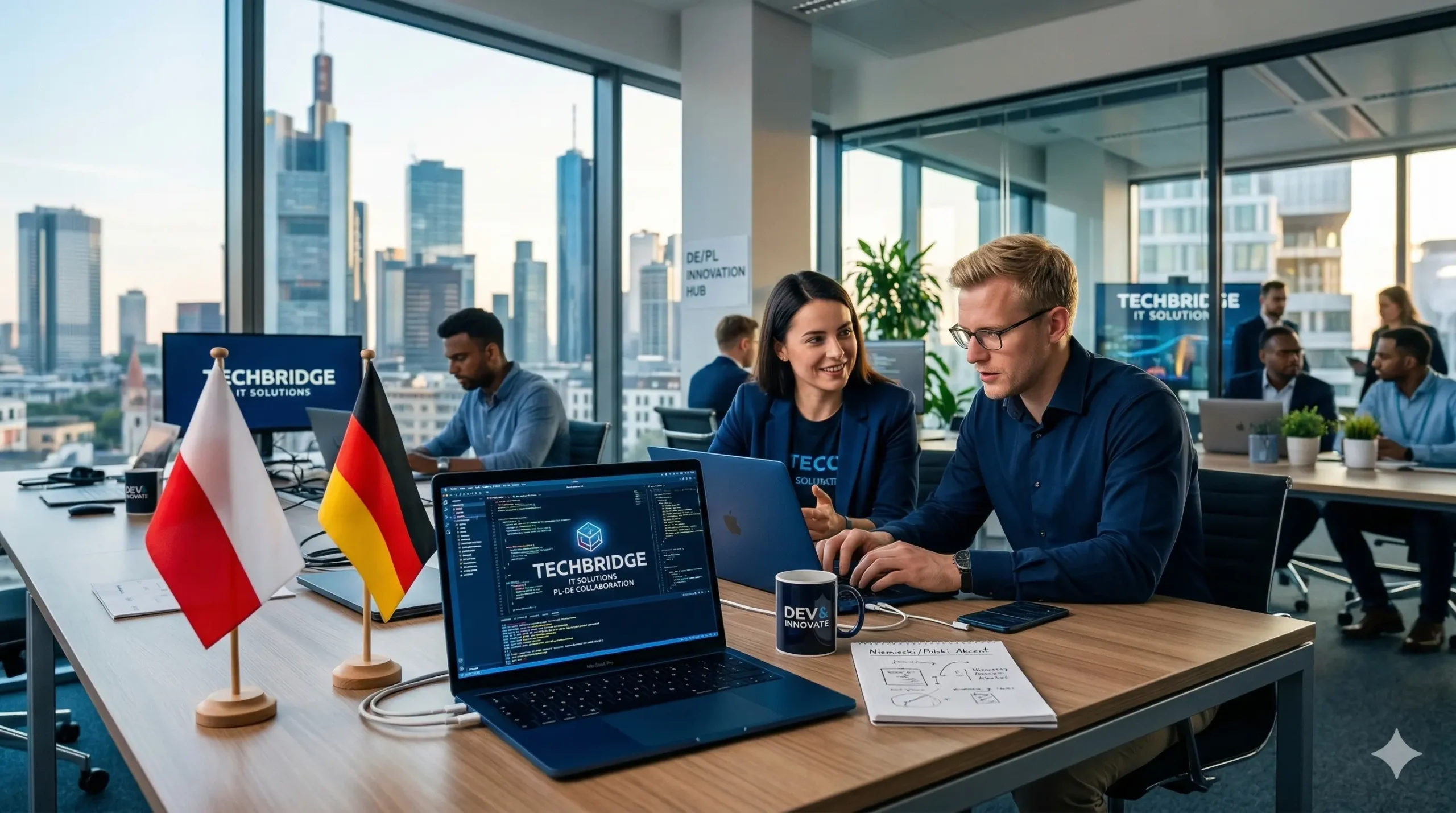
IT Nearshoring for DACH Companies: The Complete Guide to Nearshoring Poland
German, Austrian, and Swiss companies face a specific version of a problem that every technology-driven business knows: the domestic IT talent market is too tight, too expensive, and too slow. In Germany, the IT skills shortage has been a consistent headline for years — not a temporary dip, but a structural gap between the number of qualified engineers the economy needs and the number it can produce. Austria and Switzerland face similar dynamics, compounded by some of the highest engineering salary expectations in Europe.
Many DACH companies eventually decide to nearshore Poland — and the ones that get there early tend to stay. This guide explains why, how the model works in practice, and what to think about before you start.
Key Insights
- Poland and Germany share the CET/CEST time zone — meaning full working-hour overlap with no compromise, standup to end of day.
- With approximately 600,000 programmers and 80,000+ STEM graduates entering the workforce annually, Poland has the largest tech talent pool in Central and Eastern Europe.
- Nearshoring to Poland cuts IT labour costs by 30–50% compared to Germany, Austria, and Switzerland — while maintaining comparable engineering quality and delivery standards.
- Poland ranks top 3 globally for programmer quality (HackerRank) and 13th in the EF English Proficiency Index — both in the “Very High” tier.
- Warsaw to Berlin is a 70-minute flight. Warsaw to Frankfurt, Vienna, and Zürich are under two hours. Face-to-face collaboration is genuinely easy.
- Operating under EU law and GDPR, Poland provides the same legal and data protection framework that DACH companies already operate within — no additional compliance layer required.
- Cultural alignment between Polish and German-speaking professionals is strong: similar work ethics, directness in communication, and shared European business norms.
Why is the DACH IT talent market so difficult right now?
Germany has around four million registered businesses. It also has one of the highest rates of digital transformation investment in Europe. And yet Bitkom’s 2025 study confirms 109,000 IT positions remain unfilled in Germany, with 85% of companies reporting talent shortages — a figure that has been growing, not shrinking, for the better part of a decade.
The core problem isn’t ambition, it’s arithmetic. German universities produce capable engineers, but not at the volume the economy requires. The hiring process for senior developers in Munich, Frankfurt, or Hamburg regularly stretches to four to six months. When a position is filled, salary expectations — particularly in software engineering, cloud, and data — have risen sharply since 2020. A senior software engineer in Germany typically costs €80,000–€120,000 per year in salary alone, before employer contributions, benefits, and recruiting costs are added.
Austria and Switzerland operate in the same dynamic, with Swiss engineering salaries among the highest in Europe. For companies trying to scale technical teams quickly — whether for a digital transformation project, a product build, or a growing data infrastructure — the domestic market simply cannot move at the speed the business needs. Germany’s Federal Statistical Office data on employer labour costs confirms that total employment costs for technical specialists in Germany are among the highest in Europe — a direct driver of nearshoring interest.
This is where nearshoring in Poland enters the conversation. Not as a compromise, but as a structurally better option for many types of IT work.
Why does Poland work so well specifically for DACH companies?
For companies based in Western Europe, the geographic and operational fit with Poland is better than with almost any other nearshoring destination — and for DACH companies specifically, a few factors make it particularly natural. New to the nearshoring model itself? Our complete guide to IT nearshoring covers the fundamentals before you dive into the DACH-specific picture. Germany Trade & Invest’s overview of the domestic IT industry also provides useful context on the structural pressures driving DACH companies toward nearshore alternatives.
Is the time zone difference actually zero?
Yes — and this is not a trivial advantage. Poland operates in CET in winter and CEST in summer, which is exactly the same time zone as Germany, Austria, and Switzerland. When your team in Munich starts at 9am, your nearshore team in Warsaw starts at 9am. There is no scheduling compromise, no asynchronous lag for decisions, no “let’s catch them before they log off” urgency. The daily collaboration rhythm feels identical to working with a team in the next office building.
This full overlap is something that no other major nearshoring destination can offer DACH companies. Romania and Ukraine are CET+1 or CET+2. India and Southeast Asia require night shifts on one side of the relationship. Even nearshoring to Spain or Portugal involves a one-hour difference in some seasons. Poland sits in exactly the right position on the map.
How close is Poland physically?
Warsaw is a 70-minute flight from Berlin and under two hours from Frankfurt, Vienna, and Zürich. That’s closer than many domestic destinations — the flight from Munich to Hamburg, for example, is roughly the same duration. For teams that value occasional in-person collaboration — sprint reviews, kickoffs, planning sessions — visiting your Polish nearshore team is genuinely no more burdensome than a domestic business trip.
This matters because the best nearshore relationships aren’t purely remote. Quarterly visits from one or both sides consistently improve team cohesion, accelerate trust, and reduce the ambiguity that can build up in distributed teams over time. The proximity to Poland makes this practical rather than aspirational.
What about language?
Polish IT professionals working with international clients typically speak fluent English, and English is the standard working language for all professional IT delivery. German language skills among Polish engineers vary — some senior professionals speak German, particularly those who have worked with DACH clients previously — but English is the reliable default, and it works consistently.
According to the Polish Investment and Trade Agency’s 2025 Investor Guide, Poland ranks 13th globally for English proficiency among non-native speaking countries, in the “Very High Proficiency” tier. For technical communication — code reviews, architecture discussions, requirements clarification — this level is entirely sufficient for effective daily collaboration.
What does the cost comparison with DACH actually look like?
The cost case for nearshoring in Poland is compelling — but it’s worth being precise about where the savings come from, rather than just citing a percentage.
KPMG Poland’s 2025 Shared Services and Global Business Services report places average Polish IT labour costs at €17.3 per hour — approximately 50% below the EU average of €33.5. Against DACH-specific salary levels, the gap is even larger: a senior software engineer in Germany or Switzerland often costs two to three times what an equivalent Polish engineer costs in total employer expenditure.
The savings compound across the full cost of employment. DACH companies running their IT teams in-house carry not just salary costs but employer social contributions (30–40% on top of gross salary in Germany), recruiting fees (typically 15–25% of annual salary for specialist roles), office space, equipment, and HR overhead. A Polish nearshore partner absorbs most of those costs within the service fee, which is often fixed and predictable month-to-month.
| Cost element | Senior engineer in Germany | Equivalent via nearshoring Poland |
|---|---|---|
| Gross annual salary | €80,000–€120,000 | €35,000–€60,000 |
| Employer social contributions (~35%) | €28,000–€42,000 | Included in service fee |
| Recruiting cost | €12,000–€25,000 per hire | Included in service fee |
| Office / equipment | €5,000–€12,000/year | Included in service fee |
| Time to hire | 4–6 months average | 4–8 weeks |
| Total annual cost to company | €125,000–€200,000 | €50,000–€75,000 |
The time-to-hire difference matters as much as the cost difference for many DACH companies. A six-month recruiting process in Germany for a senior data engineer or cloud architect means a six-month delay on whatever that person was supposed to build. A nearshore team in Poland can have the same profile operational in four to eight weeks. Over a year, that speed difference compounds into real product and revenue impact.
“Poland is not the cheapest outsourcing destination in the world. That has never been its pitch. The pitch is that you get Western European quality at a fraction of the cost, with none of the communication headaches. For our clients in the DACH region and Nordics, working with our team in Warsaw feels no different than working with a team in the next city.”
— Szymon Stadnik, CEO, ITELENCEWhat makes Poland’s IT talent pool strong enough for demanding DACH requirements?
DACH companies — particularly in Germany — tend to have high engineering standards. Thoroughness, precision, well-documented code, structured processes: these are not just preferences, they’re embedded in how German-speaking companies build and operate software. The concern that “cheaper means lower quality” is legitimate and worth addressing directly.
Poland’s engineering culture happens to align with these expectations unusually well. According to the Polish Investment and Trade Agency’s 2025 ICT Sector Report, Poland ranks in the top three globally for programmer quality based on competitive programming assessments — a measure of actual technical capability, not just credentials. The country also ranks 5th globally in the IT Competitiveness Index for the “Talent” component.
What drives this? Poland has over 600,000 IT professionals and produces more than 80,000 STEM graduates annually. Its computer science programmes — at Warsaw University of Technology, the AGH University in Kraków, and Wrocław University of Science and Technology, among others — consistently produce graduates with strong mathematical and algorithmic foundations. Polish developers are known for rigour in testing, clean architecture, and careful documentation — characteristics that align naturally with DACH engineering culture.
The specific areas where the Polish talent pool runs deep are also the areas where DACH demand is highest:
- Software development and architecture — from custom application development to complex enterprise systems
- Data engineering and analytics — pipeline design, warehousing, BI infrastructure
- Cloud and DevOps — AWS, Azure, GCP, and infrastructure-as-code at enterprise scale
- SAP consulting and development — Poland has one of Europe’s deepest SAP talent pools, particularly relevant for large DACH manufacturing and logistics companies
- AI and machine learning — a rapidly growing specialty with strong academic foundations
- Cybersecurity — increasingly important as DACH companies face escalating regulatory and threat environments
Does the legal and compliance framework cause complications for DACH companies?
This is one of the most important questions to get right before signing any nearshoring agreement — and it’s also one of the clearest advantages Poland has over alternative destinations.
Poland is a full EU member state. That means GDPR applies by default. IP assignment, contract enforcement, and employment law all operate within the EU legal framework. Data processed by a Polish nearshore team stays within EU jurisdiction. For DACH companies — who are themselves subject to GDPR and, in Germany’s case, to some of the strictest data protection enforcement in the EU via the Datenschutzbehörden — working with a Polish provider creates no additional compliance layer. The legal environment is the same one you already operate within.
This is a meaningful difference from nearshoring to Ukraine, India, or other non-EU destinations, where GDPR-compliant data transfer requires Standard Contractual Clauses, Transfer Impact Assessments, and ongoing legal monitoring. It also differs from working with providers in the UK post-Brexit, where the adequacy decision that enables data transfer is subject to ongoing review.
For DACH companies in regulated sectors — financial services under BaFin, healthcare under MDR, or critical infrastructure under NIS2 — the EU legal framework means your Polish nearshore partner operates under the same regulatory geography as your own organisation. This simplifies third-party risk assessments, data processing agreements, and audit processes significantly.
What about intellectual property?
Polish law provides robust intellectual property protections fully compatible with German, Austrian, and Swiss IP law. Standard nearshoring contracts include explicit IP assignment clauses — all code, designs, and documentation produced by the nearshore team are assigned to the client. NDAs are standard practice before any engagement begins. For DACH companies with proprietary software or sensitive client data, the legal protection is comparable to engaging a provider in your own country.
Based in Germany, Austria, or Switzerland and considering nearshoring to Poland?
We work with DACH companies from first conversation to operational nearshore team — typically within four to eight weeks. Let’s discuss your specific situation.
What delivery models are available for DACH companies nearshoring to Poland?
There is no single right way to structure a nearshore IT engagement. The right model depends on the size of your existing internal team, how much control you want to retain over day-to-day work, and how quickly you need to move. Here are the main options, and what each one is actually suited to.
IT staff augmentation — individual specialists joining your team
The simplest and most common starting point. You identify a specific role your internal team is missing — a senior backend developer, a data engineer, a cloud architect — and Itelence recruits and places that person alongside your existing staff. They work in your tools, follow your processes, and report directly into your team structure. You maintain full day-to-day oversight.
This model works well as a first step into nearshore development in Poland because the risk is low and the integration is straightforward. Many DACH companies start with one or two augmented specialists to validate the quality and working relationship before expanding.
Dedicated nearshore team — a self-contained delivery unit
As the engagement grows, many companies transition to a dedicated team model: a structured group of five to twenty engineers with their own team lead, working as a delivery unit for defined parts of your product or technology stack. The team has its own processes and ceremonies but operates in close coordination with your internal teams.
This is the model that tends to generate the strongest long-term results for DACH companies. It provides enough scale for meaningful independent delivery while maintaining the close alignment that comes from operating in the same time zone and cultural context. IT nearshoring Poland through a dedicated team structure is how most mature Itelence relationships operate.
Build-Operate-Transfer — for companies planning to own their Polish team
Some DACH companies have a longer-term ambition: to build a Polish technology centre that they eventually own and operate themselves. The Build-Operate-Transfer model structures this as a three-phase engagement — Itelence builds the team, manages it through operational maturity, then transfers ownership to the client. It’s a way to achieve the benefits of a Polish technology centre without taking on the full setup risk from day one.
| Model | Best suited to | Control level | Typical team size | Time to start |
|---|---|---|---|---|
| Staff augmentation | Filling specific skill gaps, first-time nearshoring | High — direct management | 1–5 specialists | 2–4 weeks |
| Dedicated nearshore team | Scaling delivery capacity, defined workstreams | Medium — team lead layer | 5–25 engineers | 4–8 weeks |
| Managed IT services | Ongoing operations, support, infrastructure | Low — outcome-based | Variable | 4–8 weeks |
| Build-Operate-Transfer | Long-term Polish tech centre ownership | Full ownership at transfer | 10–50+ | 3–6 months |
What does a nearshoring engagement actually look like in the first 90 days?
The first three months of a nearshoring relationship tend to define whether it becomes a long-term asset or a frustrating experiment. Here’s what a well-run engagement looks like in practice for a DACH company working with Itelence.
Weeks one and two are scoping: a structured intake process in which Itelence maps your technical requirements, team structure, existing tooling, and delivery goals. This isn’t just a job description exercise — it’s a conversation about how the nearshore team will integrate with your existing engineers and what “success” looks like at 90 days, 6 months, and 12 months.
Weeks three through six are recruitment and onboarding. Itelence presents candidates against the agreed profile; you interview them exactly as you would an in-house hire. Once selected, the onboarding process mirrors your internal practices — access to your codebase, your Jira, your Confluence, your Slack. The nearshore team joins your existing rituals: standup, sprint planning, retrospective.
From week six onwards, the engagement moves into steady-state delivery. The coordination overhead reduces as working patterns establish. Communication becomes habitual rather than conscious. Most DACH companies report that within three months, their Polish nearshore colleagues feel like part of the team rather than an external supplier.
One thing that consistently makes the first 90 days smoother: designating a clear internal point of contact on your side who owns the day-to-day relationship with the nearshore team. Not a manager who coordinates once a week, but someone who is reachable for the nearshore team in real time. In the same time zone, this is easy — and it makes an enormous difference to how quickly trust and productivity develop.
Which DACH industries are most active in nearshoring IT to Poland?
Nearshore IT outsourcing from Germany, Austria, and Switzerland to Poland spans virtually every sector, but a few industries have been particularly active — often because their specific IT requirements align especially well with what the Polish talent market offers.
Manufacturing and industrial technology companies — the Mittelstand backbone of the German economy — have historically been heavy users of SAP. Poland has one of Europe’s deepest SAP consulting talent pools, which makes it a natural fit for companies running complex SAP landscapes who cannot find enough SAP-competent resources domestically. SAP consulting and nearshore development is one of Itelence’s core service areas precisely because of this demand from DACH clients.
Financial services firms across Germany, Austria, and Switzerland face a dual pressure: regulatory requirements that demand strong data governance and security, and digital transformation programmes that require continuous software development capacity. Poland’s EU legal framework addresses the compliance dimension; the depth of the Polish developer pool addresses the capacity dimension.
E-commerce and retail technology is another active area. German-speaking markets have some of the most demanding e-commerce customer bases in Europe, and companies scaling their online operations need development and data teams that can move quickly. Nearshore software development services in Poland — covering full-stack development, UX, performance optimisation, and data analytics — provide that capacity without the hiring bottleneck of the domestic market.
Beyond these sectors, DACH companies in logistics, healthtech, insurtech, and professional services have all built successful Poland-based nearshore IT operations. The common thread isn’t the industry — it’s the need to scale a technically capable team faster and more cost-effectively than the local market allows.
For a deeper look at how Poland has developed as a delivery hub for international business, our article on Poland’s rise as an IT outsourcing and BPO hub covers the structural factors in detail. You can also explore why Poland leads Europe’s IT nearshoring market for a broader competitive analysis.
Is nearshoring to Poland the right move for your DACH company right now?
The question is worth being direct about. Nearshoring works well when a company has a clear technical need, enough internal structure to integrate a remote team, and a genuine motivation — whether cost, speed, or talent access. It works less well when the engagement is vague, the internal ownership is unclear, or the company expects the provider to define the strategy rather than execute it.
For DACH companies specifically, nearshoring in Poland tends to be the right move when:
- You have been trying to fill one or more specialist IT roles domestically for more than three months without success.
- You need to scale your development or data team by five or more people within the next six months, and the local hiring pipeline cannot support that pace.
- Your IT budget is under pressure and you need to reduce the cost of ongoing development or operations without reducing output quality.
- You are running a digital transformation project that requires temporary but substantial capacity — a team that needs to exist for 12–24 months, not permanently.
- You want to move into a specific technology area — AI, data engineering, cloud migration — where German-speaking specialists are genuinely scarce and expensive.
Itelence has been working with DACH companies on exactly these challenges for years. The model is proven: low initial investment, fast time to operational team, scalable as confidence grows. You can begin with a single nearshore specialist through IT staff augmentation and expand into a full nearshore software development team in Poland as the engagement matures. For companies with data engineering needs specifically, our guide on building a nearshore data engineering team from Poland covers that specialisation in depth. When it’s time to evaluate and compare providers, our 12-point partner evaluation framework gives you a structured methodology. UK companies considering similar moves can find a parallel analysis in our guide on how UK companies approach nearshoring to Poland.
Ready to discuss nearshoring for your DACH company?
Tell us what you need — role profiles, team size, technology stack, timeline. We’ll come back to you with a realistic proposal, not a generic brochure.
Frequently Asked Questions
Questions DACH companies most commonly ask when considering IT nearshoring to Poland.
Is Poland really in the same time zone as Germany, Austria, and Switzerland?
How much can a DACH company realistically save by nearshoring IT to Poland?
Do Polish IT professionals work in German, or is English the standard language?
Does GDPR compliance work the same way with a Polish nearshore provider as with a German one?
How long does it take to get a nearshore team in Poland operational?
Can a Polish nearshore team handle SAP work for a German manufacturing or logistics company?
How does the cultural fit between Polish and German-speaking professionals actually work in practice?
What is the best model for a DACH company starting nearshoring for the first time?
Is it practical to visit the nearshore team in Poland in person?
Can Itelence provide nearshore IT services across different specialisms, or only software development?