

IT Nearshoring and IT Offshoring: Choosing the Right Global IT Strategy for Your Business
Two vendors quote you the same project. One sits three time zones away and answers your Slack messages before lunch. The other sits eleven time zones away and costs 30% less per hour. That single trade-off, overlap versus rate, is the heart of the nearshore vs offshore decision, and most teams get it wrong by optimising for the number on the invoice instead of the cost of the delay.
This guide defines both models, lays out seven concrete differences, and gives the pros and cons of each so you can match the model to the work. Both are forms of outsourcing separated by distance: Gartner defines offshoring as relocating jobs or organisational functions from one country to another to reduce labour cost, while nearshoring, also called near shoring or nearshore outsourcing, does the same to a nearby country that preserves time-zone overlap. Nearshore vs offshore is not a question of which is “better”; it is a question of which trade-off your project can absorb. Below you will find what nearshoring and offshoring mean in software programming, how they differ across cost, time zone, communication, and control, which destinations US companies actually use, and where IT nearshoring Poland fits into that decision.
Key Insights
- Nearshoring outsources software work to a nearby country, typically within 1 to 3 time zones, while offshoring sends it to a distant region 7 to 12 time zones away. Proximity, not price, is the defining variable.
- Offshoring usually wins on hourly rate; nearshoring wins on collaboration. A distant vendor can quote a lower rate per hour, yet a 6-hour overlap window often delivers work faster in calendar time.
- Time-zone overlap is the single most decisive factor. Poland gives a US East Coast team roughly 4 to 6 hours of shared working time per day; India gives close to zero.
- Poland has approximately 600,000 programmers, more than 25% of the entire development community in Central and Eastern Europe, according to the Polish Investment and Trade Agency’s 2025 IT Sector Report.
- Cost is no longer the top reason companies outsource. In Deloitte’s 2024 Global Outsourcing Survey, cost reduction fell to third place at 34%, down from 70% in 2020, while access to specialised talent became the leading driver at 42%.
- The decision rule is simple: choose offshoring for well-specified, low-interaction work where cost dominates; choose nearshoring for collaboration-heavy work where feedback loops decide the outcome.
- Hybrid models exist. Many US firms run a nearshore core team in Europe and an offshore team in Asia for after-hours coverage, using the time gap as a feature rather than a problem.
What is nearshoring in programming?
Nearshoring in programming is the practice of contracting software development to a company in a nearby country, usually within one to three time zones of the client. The term describes a middle path between keeping work in-house and sending it to the far side of the world. Also called nearshore software programming or nearshore software development, it prioritises time-zone overlap, cultural proximity, and short travel over the lowest possible hourly rate.
A US company hiring engineers in Mexico or Costa Rica is nearshoring. A German company hiring engineers in Poland is nearshoring. The defining feature is not the specific country; it is that the vendor sits close enough for real-time collaboration during a normal working day. Nearshore development Poland is the classic European example: a Warsaw team overlaps with London for a full workday and with New York for most of the afternoon.
Software is a collaboration-intensive product. When a developer needs a decision, a two-hour wait is friction, but a fourteen-hour wait is a lost day. To see the full definition and its variants, read our complete guide to what IT nearshoring is.
What is offshoring in programming?
Offshoring in programming is the practice of contracting software development to a company in a geographically distant country, typically 7 to 12 time zones from the client, chosen primarily for lower labour costs. India, the Philippines, and Vietnam are the classic offshore destinations for US and Western European firms. The model trades proximity for price: the hourly rate drops, and the time-zone gap widens.
Offshoring is the older and larger of the two models by headcount, and it built the global IT services industry. The global IT services outsourcing market reached USD 807.91 billion in 2025 and is projected to hit USD 1,219.31 billion by 2030, according to Grand View Research, with India alone accounting for more than 55% of provider-side delivery. Offshoring still dominates commodity work, such as maintenance, testing, and high-volume back-end development, where requirements are stable and constant real-time contact is not required.
A low hourly rate does not always translate into a low total cost. When a nine or eleven-hour gap forces every clarification into a 24-hour round trip, rework and delay quietly erode the savings. Our analysis of real offshoring examples documents where that math works and where it breaks.
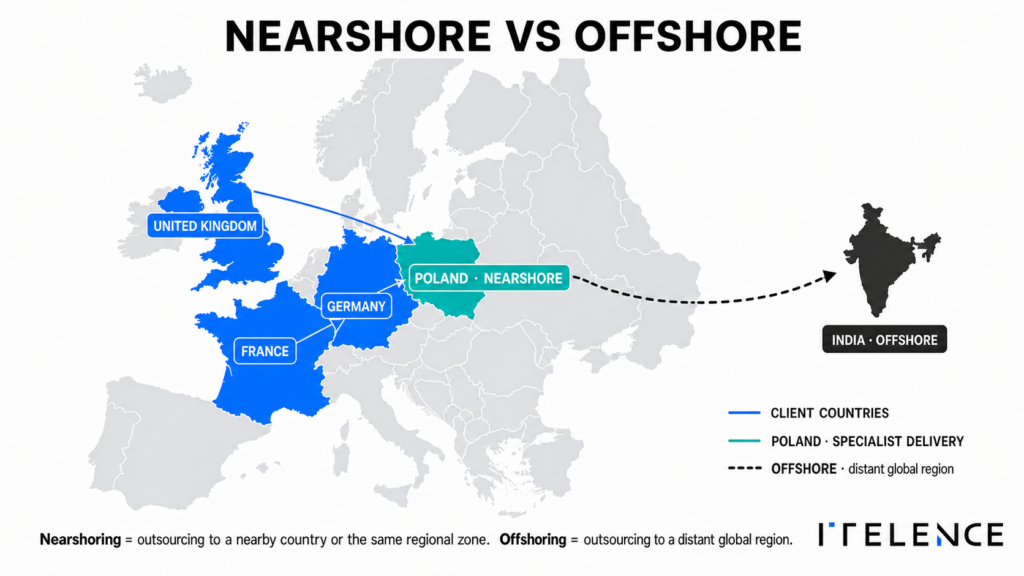
What is the difference between nearshoring and offshoring?
The core difference between nearshoring and offshoring is distance, in that nearshoring outsources to neighbouring or near-region countries, while offshoring outsources across the globe. Everything else, including cost, overlap, communication, travel, and oversight, follows from that single geographic choice. Think of it as one country radiating outward: for a US client, Mexico and Canada are nearshore, Poland is near-region nearshore for Europe, and India and the Philippines are offshore.
The seven differences below turn that geography into practical consequences.
| # | Dimension | Nearshoring | Offshoring |
|---|---|---|---|
| 1 | Geography | Neighbouring or same-region country | Distant region, another continent |
| 2 | Time-zone gap | 1 to 3 hours | 7 to 12 hours |
| 3 | Daily overlap | 4 to 8 shared working hours | 0 to 3 shared working hours |
| 4 | Hourly rate | Moderate (mid-range) | Lowest available |
| 5 | Communication | Real-time, synchronous | Mostly asynchronous |
| 6 | Travel | Short flight (1 to 3 h in-region) | Long-haul (8 to 14 h) |
| 7 | Cultural fit | High (shared business norms) | Variable, often larger gap |
Read across any row and the trade-off is the same: nearshoring buys overlap and immediacy, offshoring buys a lower rate. This is where cost-obsessed buyers slip, because the cheapest rate rarely produces the cheapest project.
“The mistake we see most often is treating this as a pure cost decision. On collaborative work, a six-hour overlap saves more in avoided rework than a lower rate ever does.”
— Szymon Stadnik, CEO, ITELENCEWhat are the advantages of nearshoring?
The main advantage of nearshoring is a large overlap in working hours that keeps feedback loops short. When your team and your vendor share 4 to 8 hours a day, a blocker raised at 10 a.m. is resolved the same morning, not the next. That single property compounds across a project into faster delivery and fewer misunderstandings.
The concrete advantages of nearshoring are:
- Real-time collaboration removes the 24-hour round trip on every question.
- Cultural alignment reduces friction in requirements, code review, and product decisions.
- Short travel makes quarterly on-site visits practical, a 2 to 3 hour flight instead of a two-day journey.
- Easier compliance applies when the vendor sits inside the same regulatory bloc, such as the EU and its GDPR framework.
- Deeper talent access in near-region hubs, where nearshore IT services Poland draw on the largest developer base in Central and Eastern Europe.
Nearshoring suits products under active development, where scope changes weekly and the cost of a slow answer is high.
What are the disadvantages of nearshoring?
The main disadvantage of nearshoring is a higher hourly rate than the cheapest offshore destinations. A near-region senior developer typically costs more per hour than an equivalent offshore hire, so for pure cost-minimisation on stable, low-interaction work, nearshoring loses on the raw number.
The disadvantages to weigh are:
- Higher hourly rates than the lowest-cost offshore markets, sometimes by 20% to 40%.
- Smaller absolute talent volume in some near-region countries than in the massive offshore labour markets of India or the Philippines.
- Limited 24/7 coverage, because a single nearshore team works your hours, not the clock around.
- Variable rates within the region, since nearshore spans both budget and premium markets.
The nearshore premium may not pay for itself when your work is a well-specified, high-volume task with little need for daily contact.
Weighing overlap against hourly rate for your next build?
Itelence helps US and European companies scale engineering teams from Poland with full-workday overlap and EU-grade compliance.
What are the advantages of offshoring?
The main advantage of offshoring is the lowest available hourly rate combined with enormous talent volume. Distant markets such as India, the Philippines, and Vietnam offer the largest pools of developers in the world at rates below any near-region option, which makes offshoring the strongest choice when cost per hour is the dominant constraint.
The advantages of offshoring are:
- Lowest hourly cost among all outsourcing models.
- Massive scale, letting you staff dozens of engineers quickly.
- Round-the-clock progress, because the time gap means work continues while your office sleeps.
- Mature delivery machinery for commodity work, including testing, maintenance, and support run by highly process-driven vendors.
Offshoring earns its keep on stable, well-documented workstreams where requirements rarely change mid-sprint.
What are the disadvantages of offshoring?
The main disadvantage of offshoring is a time-zone gap that pushes nearly all communication into asynchronous cycles. When your vendor shares 0 to 3 working hours with your team, every clarification risks a full-day delay, and those delays accumulate into rework, missed context, and slipped deadlines that eat into the hourly-rate savings.
The disadvantages to plan for are:
- Minimal overlap turns quick questions into 24-hour round trips.
- Wider communication gaps open with distance, language, and culture.
- Long-haul travel, often 8 to 14 hours, makes in-person contact rare and expensive.
- Weaker real-time oversight, which raises the risk on fast-moving or ambiguous work.
- Cross-border compliance complexity increases when data leaves your regulatory bloc.
Offshoring struggles most on early-stage, discovery-heavy products where the specification is still moving.
Why should you choose nearshoring?
Choose nearshoring when collaboration decides the outcome. The overlap a nearshore partner provides is worth more than the rate difference when your product is evolving, your requirements shift sprint to sprint, and your team needs answers within the same working day. Nearshore software development Poland gives US and Western European companies senior engineers who share most of the working day, work inside the EU compliance perimeter, and sit a short flight away.
The appetite for this model is growing. In 2025, 26% of companies globally planned to nearshore, a figure that rose to 33% among US firms, according to QIMA’s nearshoring and reshoring data. The strongest case for nearshoring appears in three situations: building a new product where scope is uncertain, extending an in-house team that needs daily contact, and running regulated work where data must stay inside the EU. To pressure-test a vendor against objective criteria, use our 12-point framework for choosing a nearshore software partner.
Nearshoring in Poland has become the default near-region choice for European buyers precisely because it combines a deep talent pool with full-workday overlap, the two things a fast-moving product needs most.
Poland’s depth is documented in KPMG’s Shared Services and Global Business Services in Poland report, which tracks the growth of Poland’s business services sector into one of Europe’s largest.
Why should you choose offshoring?
Choose offshoring when cost dominates and the work is stable. The lowest hourly rate wins, and the time-zone gap becomes a manageable constraint rather than a daily obstacle, when your task is well-specified, requires little day-to-day interaction, and runs at high volume, such as maintenance, regression testing, or steady back-end development.
Offshoring is also the right answer when you deliberately want 24-hour progress. A US team can hand off work at 6 p.m. and receive completed output the next morning, using the eleven-hour gap as a feature. The model rewards mature processes: the more precisely you specify the work up front, the more offshoring delivers.
Many companies do not choose one model exclusively. A common hybrid keeps a nearshore core team for product-critical, collaborative work and adds an offshore team for after-hours coverage and commodity tasks, capturing the overlap of one and the rate of the other.
How do nearshoring and offshoring compare across countries?
Nearshoring and offshoring map onto different sets of countries depending on where the client sits. For a US buyer, nearshore means the Americas and, increasingly, Europe, while offshore means Asia. The two subsections below list the destinations US companies actually use and quantify the time-zone gap that separates them.
What are the top nearshore destinations for US companies?
The top nearshore destinations for US companies are Mexico, Poland, Costa Rica, Colombia, and Argentina. Mexico and the Central American countries offer near-identical time zones to the US and a short flight. Poland, though technically near-region rather than adjacent, has become a leading nearshore destination for US firms because it combines a 600,000-strong developer pool with a full afternoon of East Coast overlap.
The pattern US technology leaders report is consistent: Latin America for maximum time-zone alignment, Poland for depth of senior engineering talent and EU compliance. Our comparison of nearshore IT outsourcing for US companies, Poland vs Latin America, breaks down where each wins. Poland’s position is reinforced by Eurostat’s data on ICT specialists in employment, which ranks it among the largest technology workforces in the European Union, and by the European Commission’s 2024 Digital Decade country report for Poland, which tracks the country’s growing digital talent base.
What are the top offshore destinations for US companies?
The top offshore destinations for US companies are India, the Philippines, and Vietnam. India leads on scale and maturity, the Philippines on English-language support and back-office work, and Vietnam on cost and a fast-growing engineering base. All three sit 10 to 13 time zones from the US East Coast, which is exactly what defines them as offshore.
The table below quantifies the gap that separates nearshore from offshore for a New York based team. Time-zone difference is the clearest single measure of how much of your working day you can share with a vendor.
| Destination | Model (for US) | Time zone | Difference vs New York (EST) | Daily overlap with NY (9 to 5) |
|---|---|---|---|---|
| Poland | Nearshore (near-region) | CET (UTC+1) | 6 hours | ~2 to 3 hours (afternoon) |
| Mexico City | Nearshore | CST (UTC-6) | 1 hour | ~7 hours |
| Brazil (São Paulo) | Nearshore | BRT (UTC-3) | 2 hours | ~6 hours |
| India | Offshore | IST (UTC+5:30) | 10.5 hours | ~0 to 1 hour |
| Philippines | Offshore | PHT (UTC+8) | 13 hours | ~0 hours |
| Vietnam | Offshore | ICT (UTC+7) | 12 hours | ~0 hours |
Read the last column, not the fourth: overlap is what you actually collaborate in. Poland’s 6-hour gap still leaves a US East Coast team a working afternoon together, while India’s 10.5-hour gap leaves almost none. That is the entire nearshore vs offshore trade-off compressed into one column.
Why should you choose Itelence as your nearshoring partner?
The nearshore vs offshore decision comes down to one question: does your work live or die by the speed of the feedback loop? If it does, proximity wins, and Poland offers the deepest near-region talent pool in Europe with real-time overlap for both US and Western European teams. If your work is stable and cost-led, an offshore or hybrid setup may fit better, and an honest partner will tell you so.
Itelence builds nearshore software development teams from Poland for companies that need senior engineers, EU compliance, and a shared working day. Whether you are extending an in-house team, launching a new product, or comparing models before you commit, our IT nearshoring Poland services give you access to vetted engineers without the overhead of setting up your own entity. Talk to our team to map the right model to your roadmap.
Want senior engineers who share your afternoon?
Itelence builds dedicated nearshore development teams from Poland with real-time overlap, transparent pricing, and EU data protection built in.
Frequently Asked Questions
These questions cover the edge cases the main sections leave open, from AI’s effect on offshoring to how much time-zone overlap a project actually needs.
Is AI replacing offshoring?
What is the difference between staff augmentation and dedicated development teams?
What are the best offshore agencies?
What is the difference between nearshoring and offshoring in one sentence?
Is nearshoring more expensive than offshoring?
Which is better for a startup, nearshore or offshore?
Can I combine nearshoring and offshoring?
Why do US companies nearshore to Poland instead of Latin America?
Does offshoring create compliance risks?
How much time-zone overlap do I need?